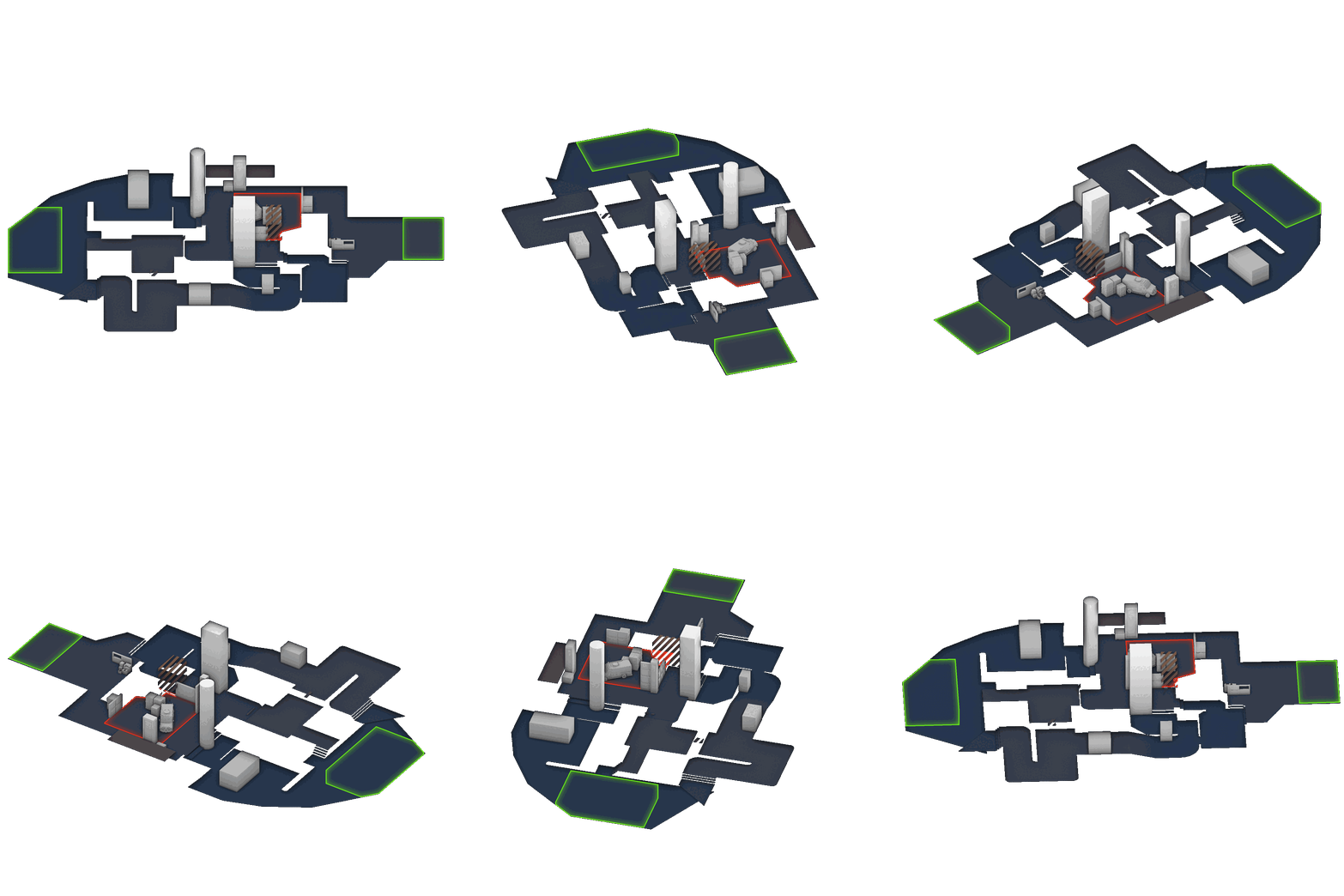
CS_Killhouse Wingman Map
Hammer/Source 2 Engine
Overview
I decided that I wanted to make a map for Counter-Strike 2's wingman mode. Wingman is a game-mode in Counter-Strike 2 where the map is focused around a singular bombsite in a 2v2 setting. My goal with this map was to create a fast-paced layout that encourages a mixture of different engagement ranges with the bombsite being more close to medium range and flank routes focusing on long range engagements.

Paper Planning
To start the process of creating the map, I first needed to begin learning the engine itself. Source 2 is closer to a modelling software than it is a typical Level Design package allowing for really rapid prototyping with increased options in terms of block out geometry.
After learning the basics I began planning my level. My main goal with this map was to create something that was easy to understand while also providing plenty of opportunities for interesting gun fights to take place. I also needed to ensure that the map was made in a way so there wasn't too many sightlines for attackers to check when clearing through the lanes.
Initial 2d Plan
During one of our earlier playtests I got some feedback that the space felt too open and that there were far too many sightlines to check for Attackers. This was especially prominent in the middle part of the map where the player is able to drop from middle window.
To remedy this issue, I changed the middle part of the map to be separate from the bombsite and added a large full size wall in-between the site and the lane. Previously, this was a half-height wall that encouraged defenders to try and head glitch attackers coming from both middle and long. Adding this walled off area into the map came with a number of positive effects: it meant that Attackers who decided to drop from mid window wouldn't have to worry about so many angles, Defenders had a wall to place their back against in site where they are able to watch the more direct top-lane into A and the flank route at the bottom of the site wasn't exposed so heavily to defenders when attackers would edge closer to the site. The area did seem like it would be a highly beneficial spot for defenders but to counteract that I made the wall fully wall-bangable, this meant that attackers could clear that angle with their shots rather than having to fully peak that angle and expose themselves.
The top lane also underwent some changes, the route was made to be more direct and the cover in the room was moved to be in the middle of the room, almost creating a loop. This was mainly done to block off a long sightline from an area on CT side before reaching the site and the room itself. A window was also added in the wall facing the bombsite to facilitate any grenade line-ups players could come up with.
Iteration


Conclusion & Takeaways
During this process I learnt a lot about building multiplayer PVP levels, it was a genre I had never built levels for before so it was incredibly interesting to learn about it. One of the main takeaways I got from this is the huge level of importance playtesting and constant iteration has when it comes to PVP design. With the wide variety of players that can walk into your map and see a space completely differently to how you do, it is incredibly important to get as many viewpoints as possible.
Another idea to takeaway from this is that although some principles apply across games, when it comes to multiplayer PVP design, you must cater your initial designs to fit within the game you are building for. As an example, it may normal to have plenty of cover on a call of duty/battlefield map for people to use but when it comes to maps in Counter Strike, cover can actually have a negative effect on the map when used incorrectly. I realised that a lot of the gameplay players enjoy in Counter-Strike is clearing a room methodically rather than just jumping in and hoping you see someone. For this reason, adding too much cover was creating too many places to hide and, coincidentally, adding too many sightlines for the player to check. This process was incredibly fun and interesting, the constant iteration made building the map really smooth and rewarding. I plan to make more Counter-Strike maps after this one, perhaps building a full-size competitive map next.